BIKE AS A SHOP. Throughout our trek through India, we were impressed by the diverse and practical use of bicycles. This fellow carried and sold water jugs of various sizes and styles on his bike. So, in addition to a 45-lb. bike, we figured he had at least an additional 120 lbs. to carry. Can you imagine the balance this takes? He won't go anywhere fast, but he'll have his shop with him when he gets to where he wants to go.
Saturday, January 05, 2008
REFLECTIONS OF INDIA - BICYCLE AS A SHOP
January 5, 2007 - to Hosur, Karnataka
CLIMB EVERY MOUNTAIN. “On the Eleventh Day of Christmas my True Love gave to me...” -- eleven mountains to climb! Out of 97 kilometers (60.5 miles) we pedaled on this day last year, over half were invested in mountain climbing. The toil brought us steadily up toward the metropolis of Bangalore. The ride took us out of the state of Tamil Nadu and into Karnataka. The language changed from Tamil to Kannada.
BIKE AS A SHOP. Throughout our trek through India, we were impressed by the diverse and practical use of bicycles. This fellow carried and sold water jugs of various sizes and styles on his bike. So, in addition to a 45-lb. bike, we figured he had at least an additional 120 lbs. to carry. Can you imagine the balance this takes? He won't go anywhere fast, but he'll have his shop with him when he gets to where he wants to go.
Friday, January 04, 2008
REFLECTIONS OF INDIA - HINDU PILGRIMS
January 4, 2007 - to Dharmapuri, Tamil Nadu
FIRST HILL CLIMBS. We pedaled to within 90 miles of Bangalore on this day in January 2007. Along the way, we encountered our first major climb, a 3 kilometer-long climb up into a high plane. I thought the steep hill would never end. Half way up the hill we encountered monkeys for the first time. A group of fifteen or so of the critters were frolicking by the roadside. We were too focused on making it up the hill to stop and take photos. Near the top, a roadside vendor was selling coconuts, so we drank coconut milk and ate some of the soft center before carrying on.
HINDUS ON PILGRIMAGE. We also encountered a group of Hindu pilgrims on their way to a religious festival. These devotees were kind enough to pose for Joe James' camera. Not sure how far they had to go, but they were making the journey on foot. Hinduism is incredibly diverse in its forms, expressions and intensities of devotion by Indians. Some take its claims and religious rituals quite radically; others seem to shrug it off. I note that the same can be said of American Christians. -- John Hay, Jr.
FIRST HILL CLIMBS. We pedaled to within 90 miles of Bangalore on this day in January 2007. Along the way, we encountered our first major climb, a 3 kilometer-long climb up into a high plane. I thought the steep hill would never end. Half way up the hill we encountered monkeys for the first time. A group of fifteen or so of the critters were frolicking by the roadside. We were too focused on making it up the hill to stop and take photos. Near the top, a roadside vendor was selling coconuts, so we drank coconut milk and ate some of the soft center before carrying on.HINDUS ON PILGRIMAGE. We also encountered a group of Hindu pilgrims on their way to a religious festival. These devotees were kind enough to pose for Joe James' camera. Not sure how far they had to go, but they were making the journey on foot. Hinduism is incredibly diverse in its forms, expressions and intensities of devotion by Indians. Some take its claims and religious rituals quite radically; others seem to shrug it off. I note that the same can be said of American Christians. -- John Hay, Jr.
Thursday, January 03, 2008
REFLECTIONS OF INDIA - BIKES EVERYWHERE
January 3, 2007 - from Dindigul to Namakkal, Tamil Nadu
RIDING A TAILWIND. This day one year ago, Bob Yardy, Joe James, Indian riders Jose and Anand and I pedaled 74 miles to Namakkal in Tamil Nadu. It was our best day of riding to date. We had a tailwind and it seemed like we were riding on clouds. Each day brought us closer to Bangalore, "the Silicon Valley of India." Our goal was to arrive in Bangalore on our seventh day of riding for two days of rest and transition.
INTRIGUED BY OUR BIKES. Everywhere we stopped for a rest or for lunch, people--young and old alike--gathered around to look at our bikes and gear. 99% of bicycles in India are single-speed with heavy, one-size-fits-all frames. Our bikes have 21 gears. Folks closely examined our derailleurs, gear-shifters, cycle computers, helmets, pedals, gear shifts, and my aero bars. Some would lift our bikes, finding them very lightweight, and make excited comments to each other.
PEDAL SUPREMACY. Bikes form the backbone of basic transportation in India. They are not used for recreation, but for personal, family, and business mobility purposes. There are still more bikes on the 2,000 miles of roads we traveled than autos, trucks and motorbikes combined. It is likely that motorized vehicles are becoming much more prevalent, but they have not yet overtaken the standard bicycle. -- John Hay, Jr.
INTRIGUED BY OUR BIKES. Everywhere we stopped for a rest or for lunch, people--young and old alike--gathered around to look at our bikes and gear. 99% of bicycles in India are single-speed with heavy, one-size-fits-all frames. Our bikes have 21 gears. Folks closely examined our derailleurs, gear-shifters, cycle computers, helmets, pedals, gear shifts, and my aero bars. Some would lift our bikes, finding them very lightweight, and make excited comments to each other.
PEDAL SUPREMACY. Bikes form the backbone of basic transportation in India. They are not used for recreation, but for personal, family, and business mobility purposes. There are still more bikes on the 2,000 miles of roads we traveled than autos, trucks and motorbikes combined. It is likely that motorized vehicles are becoming much more prevalent, but they have not yet overtaken the standard bicycle. -- John Hay, Jr.
Wednesday, January 02, 2008
REFLECTIONS OF INDIA - FEAST FOR THE SENSES
January 2, 2007 - to Dindigul, Tamil Nadu
FROM FRIGID TO HOT. As I shoveled a fresh layer of snow off our sidewalk this morning in 5-degree (Fahrenheit) temperature with the windchill factor hovering at -15, I longed to be in India. There, one year ago on this day, I would have been pedaling along in a short-sleeve jersey and shorts in 90-degree temperatures under a cloudless sky. Here in Indianapolis, I dress in layers for warmth even as the frigid air takes my breath away.
A FEAST FOR THE SENSES. The trek from the outskirts of Madurai to Dindigul on January 2, 2007 was a mere 74 kilometers--our shortest ride day to that point. But even a brief ride in India is still a feast for the senses. You know it's the 21st century because of the aluminum-frame bike, the GPS unit on the handlebars and the cell phone at your side, but the ox-drawn wagon, the women carrying water jars from the hand-pump well and the mill grinding in the village makes you feel like you're in another millenia. This is the reality of India today. Ancient and modern, simple and complex, sheltered and exposed, naive and knowing, rich and poor. And all profound. -- John Hay, Jr.
FROM FRIGID TO HOT. As I shoveled a fresh layer of snow off our sidewalk this morning in 5-degree (Fahrenheit) temperature with the windchill factor hovering at -15, I longed to be in India. There, one year ago on this day, I would have been pedaling along in a short-sleeve jersey and shorts in 90-degree temperatures under a cloudless sky. Here in Indianapolis, I dress in layers for warmth even as the frigid air takes my breath away.A FEAST FOR THE SENSES. The trek from the outskirts of Madurai to Dindigul on January 2, 2007 was a mere 74 kilometers--our shortest ride day to that point. But even a brief ride in India is still a feast for the senses. You know it's the 21st century because of the aluminum-frame bike, the GPS unit on the handlebars and the cell phone at your side, but the ox-drawn wagon, the women carrying water jars from the hand-pump well and the mill grinding in the village makes you feel like you're in another millenia. This is the reality of India today. Ancient and modern, simple and complex, sheltered and exposed, naive and knowing, rich and poor. And all profound. -- John Hay, Jr.
Tuesday, January 01, 2008
REFLECTIONS OF INDIA - "HAPPY NEW YEAR!"
January 1, 2007 - to Madurai, Tamil Nadu
HAPPY NEW YEAR! We pedaled over 87 miles along National Highway 7 in the state of Tamil Nadu, India on New Year's Day 2007. And in every village and town we heard the cheerful greeting, "Happy New Year!" Perhaps this is only one of a few words or phrases many Tamil Nadu residents know in English, but it was related with gusto.
GOING TO SCHOOL. The happy greetings heartened us on our third day--one of our longest--of riding south to north, right through the center of India. Throughout the six-week ride, we encountered many uniformed school children waiting for buses and walking together to school in the towns. These boys were pretty excited to be in front of the camera. Photo by Joe James
Thanks for your interest in our effort to raise awareness and support to rebuild Umri Christian Hospital in Umri, Yavatmal, India
GOING TO SCHOOL. The happy greetings heartened us on our third day--one of our longest--of riding south to north, right through the center of India. Throughout the six-week ride, we encountered many uniformed school children waiting for buses and walking together to school in the towns. These boys were pretty excited to be in front of the camera. Photo by Joe James
Thanks for your interest in our effort to raise awareness and support to rebuild Umri Christian Hospital in Umri, Yavatmal, India
Monday, December 31, 2007
REFLECTIONS OF INDIA - NEW YEAR'S EVE
December 31, 2006 - to Palayamkottai, Tamil Nadu
NEW YEAR'S EVE. Happy New Year from India! We experienced the beginning of 2007 exactly 12 and a half hours before the folks in the American heartland rang in the New Year. Indian celebration of the New Year is similar to what happens in America, but our experience of it was among the poor. We spent some time in the markets at a busy intersection earlier in the evening—a bazaar full of what most North Americans would find bizarre.

SOAKING IT IN. Cattle roam among the crowd and traffic. A man sitting crossed legged on the ground repairs bicycles while patrons wait (I watched him repair a punctured tube without taking the wheel off the bike!). Three men carry on a vigorous conversation in sign language. The smell of curry and myriad spices wafts through the marketplace. Ripe bananas hang in bunches. Coconuts pile high on the ground. Tamil-language newspaper headlines broadcast gory details of Saddam Hussein’s hanging.
Fireworks explode in the sky, barely discernible above the noise of honking traffic. Women walk by in brightly colored saris and Punjabi suits, as ancient as Bible times--bought right off the rack! Men dress casually in a shirt and skirt-like dhoti. Instead of huddling for the midnight countdown inside--away from the harsh cold--folks go about their New Year’s Eve activities outside in eighty-degree heat and humidity. The old year passes and the new rings in. I’m sure I will never experience a New Year’s Eve like this again.
A SOUL FEAST. Pedaling along Indian roads is a feast for the eyes and soul. Taking in what is unusual becomes usual. Before long, you come to expect nothing less than another encounter that is beyond anything within range of normal in Western mentality. I was impressed by rich colors in women's dress, by great banyan trees, vast rice fields, hard working laborers, deep poverty, ingenuity and gracious hospitality.
NEW YEAR'S EVE. Happy New Year from India! We experienced the beginning of 2007 exactly 12 and a half hours before the folks in the American heartland rang in the New Year. Indian celebration of the New Year is similar to what happens in America, but our experience of it was among the poor. We spent some time in the markets at a busy intersection earlier in the evening—a bazaar full of what most North Americans would find bizarre.

SOAKING IT IN. Cattle roam among the crowd and traffic. A man sitting crossed legged on the ground repairs bicycles while patrons wait (I watched him repair a punctured tube without taking the wheel off the bike!). Three men carry on a vigorous conversation in sign language. The smell of curry and myriad spices wafts through the marketplace. Ripe bananas hang in bunches. Coconuts pile high on the ground. Tamil-language newspaper headlines broadcast gory details of Saddam Hussein’s hanging.
Fireworks explode in the sky, barely discernible above the noise of honking traffic. Women walk by in brightly colored saris and Punjabi suits, as ancient as Bible times--bought right off the rack! Men dress casually in a shirt and skirt-like dhoti. Instead of huddling for the midnight countdown inside--away from the harsh cold--folks go about their New Year’s Eve activities outside in eighty-degree heat and humidity. The old year passes and the new rings in. I’m sure I will never experience a New Year’s Eve like this again.
A SOUL FEAST. Pedaling along Indian roads is a feast for the eyes and soul. Taking in what is unusual becomes usual. Before long, you come to expect nothing less than another encounter that is beyond anything within range of normal in Western mentality. I was impressed by rich colors in women's dress, by great banyan trees, vast rice fields, hard working laborers, deep poverty, ingenuity and gracious hospitality.
Sunday, December 30, 2007
REFLECTIONS OF INDIA - A TSUNAMI-RESPONSE YOUTH HOSTEL
December 30, 2006 - to Anandapuram, Tamil Nadu
RIDING TO A YOUTH HOSTEL. I distinctly remember these two little girls at the youth hostel in Anandapuram, Tamil Nadu, India. After pedaling 75 miles from Nagercoil (via Kanniyakumari and Cape Comorin--the southern tip of India), we rode our bikes onto their campus on December 29. We spent the evening and enjoyed their singing, dancing and drama the next day before continuing our journey toward Bangalore.
TSUNAMI REPONSE. Many of the 200+ children who live at the youth hostel are part of families that suffered the full impact of the Indian Ocean tsunami in 2004. This Free Methodist hostel expanded quickly in response to the tsunami. Children live free of charge at the youth hostel (thanks to those who sponsor children for $21 per month through International Child Care Ministries) and attend local public schools. They return to their families for holidays and summer break. The level of care and Christian witness here is truly admirable. -- John Hay, Jr.
Photo by Joe James
RIDING TO A YOUTH HOSTEL. I distinctly remember these two little girls at the youth hostel in Anandapuram, Tamil Nadu, India. After pedaling 75 miles from Nagercoil (via Kanniyakumari and Cape Comorin--the southern tip of India), we rode our bikes onto their campus on December 29. We spent the evening and enjoyed their singing, dancing and drama the next day before continuing our journey toward Bangalore.TSUNAMI REPONSE. Many of the 200+ children who live at the youth hostel are part of families that suffered the full impact of the Indian Ocean tsunami in 2004. This Free Methodist hostel expanded quickly in response to the tsunami. Children live free of charge at the youth hostel (thanks to those who sponsor children for $21 per month through International Child Care Ministries) and attend local public schools. They return to their families for holidays and summer break. The level of care and Christian witness here is truly admirable. -- John Hay, Jr.
Photo by Joe James
Tuesday, March 13, 2007
MAY WE SHARE OUR EXPERIENCE WITH YOUR GROUP?
We recently completed riding over 2,000 miles on bicycles across India. The journey yielded personal insights and cultural awareness about this incredible land and its people. We found it breathtaking and inspiring!
We’ve prepared a brief but engaging multi-media presentation about the journey. It's both educational and inspiring. We're available on a limited basis to share it with school students, civic and service organizations, auxiliary groups and congregations. Our purpose is simply to share the experience. There is no cost. If you think this experience and presentation could be helpful, interesting, and/or inspiring in your setting, please contact John Hay, Jr. We will be honored to adapt it specifically (age, time, group, setting appropriate) to share with your group.
Some info about Bicycle India 2007:
- An international team of 5 riders cycling over 2,000 miles in 6 weeks – Dec. 30, ’06 to Feb. 8, ‘07
- Bicycled an average of 100 kilometers (62 miles) each day
- From the southern tip of India (Kaniyakimari) on the Indian Ocean to New Delhi – south to north
- Our purpose was to raise awareness and funds to rebuild a small charitable hospital in central India
- We blogged (scroll down and link to past posts) each day – many photos and daily encounters
- Fuller information about the project is at www.bikeindia.org
- Stayed at the home of Mahatma Gandhi on India’s Republic Day - January 26
- Visited ancient forts, the Taj Mahal, and many culturally significant sites
- Witnessed the dynamic development of India’s cities and economy juxtaposed to profound poverty
- Observed the vast cultural, religious, and geographic diversity of India
- Found the range of mobility and urban development intriguing
- Encountered a wide variety of animals, agricultural settings, and village life
- India hosts one fifth of the world’s population in a land one third the size of the United States
Thanks for your interest & involvement. Check back often for updates. We welcome your friendly comments and questions. Learn more @ www.bikeindia.org.
Monday, February 19, 2007
BACK IN THE SADDLE
TRANSITIONING. All of us are back in the saddle...a saddle of a different sort. Instead of a bicycle saddle, we're back in the saddle of our various vocations and callings. We're dealing with lingering time adjustments. We're transitioning to a much colder climate and the reality of snow. We're savoring the experience of six weeks and 2,000 miles on a bicycle in India. Hard to believe it's behind us. Now we look forward to completing our mission: making every effort to see the full $600,000 raised to rebuild Umri Christian Hospital.
Thanks for your interest & involvement. Check back for updates. Learn more @ www.bikeindia.org.
Sunday, February 11, 2007
MAKING IT HOME
JOE STILL IN INDIA. Joe flew from Delhi to Hyderabad early Saturday morning for a week of administrative meetings there. It won't be a week of biking, that's for sure. He is scheduled to conclude his extended journey in India on Saturday. We have not yet received word from our guide Sanjay Sumadre as to whether or not he arrived back in Yavatmal.
CONTRASTS STRIKE US. What a contrast in weather and culture Bob and John are experiencing. From 85 degrees (Fahrenheit) and sunshine to frigid temperatures and snow on the ground... with more expected across Illinois and Indiana
GRATEFUL. We're inestimably grateful for what we have been privileged to experience over the past six weeks. Grateful, also, for all who have encouraged us, prayed for us, supported the project, and worked faithfully behind the scenes. As we debrief and assess the project, we will be sharing our thoughts and offering specific "thanks" in coming days and weeks. Stay tuned!
Thanks for your interest & involvement. Check back often for updates. We welcome your friendly comments and questions. Learn more @ www.bikeindia.org.
Friday, February 09, 2007
END OF THE ROAD
Thursday, February 08, 2007
WE MADE IT...3,200 KILOMETERS / 2,000 MILES
POST #38
FOG. We rode north out of Kosi in a serious fog. Objects were not visible until about 30 feet in front of you. It was eerie and dangerous. We thought the fog would lift soon, but it persisted most of the way to Delhi. The moisture soaked our clothing and the spray covered our bikes. But it’s not likely anything could have dimmed our spirits or deterred us from making this last day of our cycling journey a bright one.
INTO DELHI. The sun burned the fog away by the time we reached the outskirts of Delhi, the capital city of India. We stopped at our hotel just long enough for Sanjay to drop the trailer and register. The three of us plowed our bikes through thick traffic, our experience of pedaling thru
Bangalore, Hyderabad and Nagpur serving us well. We were tired from the day’s 75-mile / 120-kilometer ride, but we were psyched as we rode into Delhi. We’d studied the map of the city enough to know where we wanted to go. This is just about the only time on the trip that Sanjay didn’t need to guide us.
CELEBRATING AT INDIA GATE. We headed straight for the India Gate in old Delhi as our “finish line.” The India Gate is a massive arch, memorializing all India’s war dead. It stands at one end of a grand boulevard on the scale of the National Mall in Washington, D.C. At the opposite end of Rajpath Marg are the Presidential buildings and India’s Parliament (we also visited these sites). Once we reached the India Gate, we lifted our bikes over our heads and celebrated the completion of the cycling portion of our journey. We’d ridden over 2,000 miles / 3,200 kilometers since starting in Nagercoil on December 30. We have much for which to be grateful.
YET TO BE COMPLETED. The cycling portion of “Bicycle India 2007” is complete. The investment portion of the project continues. Until $600,000 is raised for rebuilding Umri Christian Hospital, we will continue to pray for UCH’s revitalization, share about the mission, encourage contributions, enlist more people in involvement, and spread the story. We’re grateful for every donation that has thus far been shared. God bless you. We’re trusting that individuals, families, congregations, service organizations, and charitable contributing entities will see the value of UCH and share in its future.
THANK YOU. We will continue to post to this blog and update all who have been supporting, praying, investing, and serving. Thank you for your prayers and encouragement all along the way. What a difference you have made. God bless you! Namaste!
Thanks for your interest & involvement. Check back often for updates. Learn more @ http://www.bikeindia.org/.
INTO DELHI. The sun burned the fog away by the time we reached the outskirts of Delhi, the capital city of India. We stopped at our hotel just long enough for Sanjay to drop the trailer and register. The three of us plowed our bikes through thick traffic, our experience of pedaling thru
CELEBRATING AT INDIA GATE. We headed straight for the India Gate in old Delhi as our “finish line.” The India Gate is a massive arch, memorializing all India’s war dead. It stands at one end of a grand boulevard on the scale of the National Mall in Washington, D.C. At the opposite end of Rajpath Marg are the Presidential buildings and India’s Parliament (we also visited these sites). Once we reached the India Gate, we lifted our bikes over our heads and celebrated the completion of the cycling portion of our journey. We’d ridden over 2,000 miles / 3,200 kilometers since starting in Nagercoil on December 30. We have much for which to be grateful.
THANK YOU. We will continue to post to this blog and update all who have been supporting, praying, investing, and serving. Thank you for your prayers and encouragement all along the way. What a difference you have made. God bless you! Namaste!
Thanks for your interest & involvement. Check back often for updates. Learn more @ http://www.bikeindia.org/.
Wednesday, February 07, 2007
INDIAN MAN
RAIN, FLATS & PROGRESS TO NEW DELHI
POST #37
RAIN IN AGRA. It began raining in Agra last night around 9:00 pm. A thunderstorm went through in the middle of the night. When daybreak came, light rain, wet pavement, puddles, and mud greeted us. O, what a gloriously muddy mess we and our bikes were in by midmorning. But the rain stopped, the clouds cleared, and by midday the sun had dried the roadway. It’s been our only opportunity to use the raingear we’ve been hauling thru India. We half expected rain in the extreme south, but not this far north. Photo: In the early morning rain and gray skies, Sanjay and Bob wait for some riders to catch up.
FLATS and MORE FLATS. It was our day for flat tires. John punctured and repaired quickly. Joe hit a piece of glass that cut his tire, which took a bit more time to repair (the tire will be replaced this evening). Then John’s back tire went down...again. This time we found the culprit: the same tiny shard of glass imbedded in the tire surface. Three flats in a day after only two punctures in over 1,900 miles…interesting. Cross-country cycling requires readiness to quickly repair flat tires and access extra tires and supplies. Thanks to Bob for thinking well and ahead on these things. Photo: Vijay, age 65, talks about road conditions with our Shereesh, our host from Mumbai.
NEXT TO LAST DAY OF RIDING. We pedaled 108 kilometers / 66 miles to a little town on National Highway 2 called Kosi on this our next to last day of cycling in India. The roads have become familiar to us. We’ve become quite adept at the Indian “rules of the road.” We’re
accustomed to the diverse activity on the roadsides. We feel like we are part of it and it is a part of us. There are hardly any more unique visuals that we haven’t already captured on photo or video clips. Still, the thought that we will not be riding these roads—Seals and Crofts’ song “We May Never Pass this Way Again” comes to mind—puts us in a wistful but grateful frame of mind. Photo: Evidence of rainy and muddy conditions on John's bike.
FLATS and MORE FLATS. It was our day for flat tires. John punctured and repaired quickly. Joe hit a piece of glass that cut his tire, which took a bit more time to repair (the tire will be replaced this evening). Then John’s back tire went down...again. This time we found the culprit: the same tiny shard of glass imbedded in the tire surface. Three flats in a day after only two punctures in over 1,900 miles…interesting. Cross-country cycling requires readiness to quickly repair flat tires and access extra tires and supplies. Thanks to Bob for thinking well and ahead on these things. Photo: Vijay, age 65, talks about road conditions with our Shereesh, our host from Mumbai.
NEXT TO LAST DAY OF RIDING. We pedaled 108 kilometers / 66 miles to a little town on National Highway 2 called Kosi on this our next to last day of cycling in India. The roads have become familiar to us. We’ve become quite adept at the Indian “rules of the road.” We’re
Thanks for your interest & involvement. Check back often for updates. Learn more @ www.bikeindia.org.
Tuesday, February 06, 2007
MAUSOLEUMS, MOSQUES & FORTS
Monday, February 05, 2007
TO AGRA
POST #36
GWALIOR TO AGRA. We rode 127 kilometers / 78 miles from Gwalior to Agra today. Except for some exceptionally rough road right at the edge of Agra, the roadway was smooth and four-land most of the day. We have pedaled 2,833 kilometers / 1,756 miles since December 30th. With only two full days of riding--plus shorter tours around Agra and Delhi--our cycling days in India are numbered. We came across our Swiss cycling friend Sebastien just outside Agra and rode into the city of 1.2 million people with him. Photo: Raju from Mumbai rides north at sunrise.
THE BANDIT QUEEN. We passed through the Indian “Badlands” about 60 kilometers / 40 miles south of Agra. This is a miniature of the North American Badlands in South Dakota. This area is famous in India for being the hideout and raiding territory of “the Bandit Queen,” for which a historical
novel is written. Abused by a landowner as a girl and having watched her father’s land taken from him, Phoolan Devi became something of an Indian Robin Hood. She and her gang would hide in the craggy Badlands and hold up trucks along National Highway 3. She avoided capture for years, taunting pursuing police. Eventually Phoolan Devi confessed, repented, surrendered and was jailed. After her release, she became a member of Parliament. Her amazing story ends tragically: she was assassinated. Photo: The Indian "Badlands" south of Agra, historic hideout for "The Bandit Queen" and her gang.
AGRA AND THE TAJ MAHAL. We can now say we’ve seen the Taj Mahal. There it is, in the hazy distance, its dome just visible between two hotel buildings across the street from our place of lodging. I suppose that’s like saying you’ve seen the Statue of Liberty from the jet on its landing approach to
LaGuardia airport. You’ve seen it but not experienced it. Tomorrow, we hope to get a much closer look at this architectural wonder. John’s desire to ride his bike down the steps of the Taj Mahal doesn’t sound like it’s going to be possible, however. No bikes allowed! Not even shoes!


THE BANDIT QUEEN. We passed through the Indian “Badlands” about 60 kilometers / 40 miles south of Agra. This is a miniature of the North American Badlands in South Dakota. This area is famous in India for being the hideout and raiding territory of “the Bandit Queen,” for which a historical
AGRA AND THE TAJ MAHAL. We can now say we’ve seen the Taj Mahal. There it is, in the hazy distance, its dome just visible between two hotel buildings across the street from our place of lodging. I suppose that’s like saying you’ve seen the Statue of Liberty from the jet on its landing approach to
SUPER BOWL UPDATE. On the way to Agra, we checked in on the Super Bowl via phone a few times. John would stop at a roadside ISD phone, pay the equivalent of 50 cents, and get an update from his son, Jared. So, while we do not know much about the game itself, we do know that the Colts won (YEA!) 29-17 and that Peyton Manning is the MVP. We can't imagine what is happening in Indy this week. Pay dirt at last!
Here are a few more photos from today:
Saturday, February 03, 2007
ON TO GWALIOR...NEARER NEW DELHI
POST #35
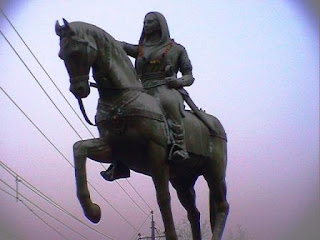
JHANSI KEE RANI. We had a bit of a history lesson before leaving the city of Jhansi this morning. Our hosts told us that Jhansi was the beginning point of India’s freedom movement against Great Britain in 1857. The story goes that a 22-year old woman named Laxmi Bai, the recent widow of the area’s Maharaja (territorial prince), rallied the town to fight the British when they tried to seize control of the area after her husband’s death. Agreements between the Maharajas and the British stated that Indians would maintain control of an area as long as there was an heir. Laxmi Bai was childless, but she and her husband had adopted a son. Upon the Maharaja’s death, the British refused to recognize the child as the next prince and moved to take control. Rallying the town to resist the British and fight for their freedom, the people occupied the local hillside fort. A traitor in their midst opened the gates and the British forces flooded in. Laxmi Bai, with her child on her back and a horse under her, leaped from the high fort wall and escaped to continue the freedom challenge. She is revered as Jhansi kee Rani…the Queen of Jhansi. Photo: Statue of Laxmi Bai in the city where she made her stand against the British...Jhansi
MEETING SEBASTIEN. Our 100-kilometer / 62-mile ride north from Jhansi to Gwalior was smooth, but not uneventful. Riding through a small town, a young man from Lausanne, Switzerland named Sebastien rode up beside John. He rode with us and ate lunch with us. We learned that he had ridden alone from Katmandu, Nepal and was touring India, eventually intending to ride to Kolkata. He left us after lunch, but we came across him not long after—his bike had broken down. We hoisted his bike on the trailer and took him on in to Gwalior. Bob spent the next three hours taking apart and repairing his back wheel hub and gear assembly. The bike is now nearly good as new (great work, Bob!) and Sebastien will be able to continue his trek. Best wishes, friend!
TEAM CHANGE. Gwalior is the location for our last exchange of Indian team members. We are saying farewell to host Ashok Sejaho and riders Yogish and Mashremkar (at 65 years of age, he’s been our oldest rider. Great job!). We welcome for the last stage of our journey a cadre from Mumbai (Bombay): host Shereesh Ahaley and riders Beejay and Raja. We look forward to getting on the road to New Delhi with them first thing Monday morning. Tomorrow,
Sunday, is an official rest day. A few of us may take a 60 km training ride / excursion in the afternoon, but not in the direction of Agra or New Delhi. Photo: Joe poses for a photo with some children who were playing cricket in a sand lot near the road. As soon as they saw a camera, the game was over...they came running.

TEAM CHANGE. Gwalior is the location for our last exchange of Indian team members. We are saying farewell to host Ashok Sejaho and riders Yogish and Mashremkar (at 65 years of age, he’s been our oldest rider. Great job!). We welcome for the last stage of our journey a cadre from Mumbai (Bombay): host Shereesh Ahaley and riders Beejay and Raja. We look forward to getting on the road to New Delhi with them first thing Monday morning. Tomorrow,
Friday, February 02, 2007
CHILD AND CHICKEN
FROM LALITPUR TO JHANSI
POST #34
COLD START, WARM FINISH. The road leading north from Lalitpur was smooth. We’re thankful for simple gifts at this point…like a relatively smooth road. When we began at 6:45 am the temperature was 52 degrees Fahrenheit; our fingers were numb and we were chilled (we know this sounds like whining to those of you mired in freezing temps, but it’s all relative, right?). But by 9:00 am it was 70; by noon it was over 80 degrees. Yep, an American Midwestern September day. The 96 kilometers / 60 miles went by uneventfully and quickly. We were in Jhansi, our day’s destination, by 12:30 pm. Photo: Yogish warms up his hands by the fire at our early morning roadside tea stop.
MARIA ACKERMAN HOYT MEMORIAL HOSPITAL. We are hosted again by a Christian hospital, one of a network of Christian hospitals across India. The Maria Ackerman Hoyt Memorial Hospital has 110 beds, a
nursing school, and gifted medical staff. They serve the city and surrounding countryside’s poor. Photo: A young Indian cyclist. Will he ride 2,000 miles across his homeland someday?
Thanks for your interest & involvement. Check back often for updates. Learn more @ www.bikeindia.org.
MARIA ACKERMAN HOYT MEMORIAL HOSPITAL. We are hosted again by a Christian hospital, one of a network of Christian hospitals across India. The Maria Ackerman Hoyt Memorial Hospital has 110 beds, a
Thanks for your interest & involvement. Check back often for updates. Learn more @ www.bikeindia.org.
Thursday, February 01, 2007
SEVEN THINGS WE THINK ABOUT
POST #33
SEVEN THINGS WE NEVER THINK ABOUT IN NORTH AMERICA BUT ASK EACH DAY WHILE CYCLING IN INDIA
1. “Is this water purified? Are you sure?” We drink only sealed bottled water.
2. If water is not coming from a faucet: “Where is the nearest well with a hand pump?” Makes you appreciate running water.
3. Because hot water is not usually readily on tap: “Do you have a hand-held electric water heating rod that I may use?” Makes you appreciate water heaters.
4. Daily reminder to oneself: “Have I taken my malaria prevention pill today?”
5. At an eatery (unless you choose to eat Indian style): “Do you have forks or spoons available?”
6. Because rolling blackouts occur throughout the country: “What hours of the day will electricity not be available?” Imagine planning your business around this. Honda has made a haul selling petrol-powered generators across the nation.
7. John’s daily quest: “Internet? Cyber cafĂ©?” If you’re reading this, we found one in the town this day.
FROM SAGAR TO LALITPUR. We rode 116 kilometers / 70.5 miles today on more rough roads from Sagar to Lalitpur. Not so many potholes as uneven and patched tarmac. Our new team of Indian riders got an immediate baptism in riding such a distance in a day. Yogish, a young man from Nagpur, experienced only our second tire puncture in over 2,400 km today. John fell on an earthen detour while trying to avoid rocks—his third spill of the journey (no injuries except to his pride). Also, one of our Indian riders fell (again, no injuries).
HARRIET BENSON MEMORIAL HOSPITAL. We left the state of Madhya Pradesh and entered the state of Uttar Pradesh, inching us nearer to New Delhi. We are privileged to be hosted in the guest house of the Harriet Benson Memorial Hospital here in Lalitpur. This is our second evening to be guests of Christian hospitals (other than Umri Christian Hospital) initiated by missionaries external to India and now led by Indian medical and operations staff. These hospitals have an important medical mission in serving the poorest of the poor with caring and quality medical care. Photo: Children from a migrant family camping near our lodging.
Thanks for your interest & involvement. Check back often for updates. Learn more @ www.bikeindia.org.
SEVEN THINGS WE NEVER THINK ABOUT IN NORTH AMERICA BUT ASK EACH DAY WHILE CYCLING IN INDIA
2. If water is not coming from a faucet: “Where is the nearest well with a hand pump?” Makes you appreciate running water.
3. Because hot water is not usually readily on tap: “Do you have a hand-held electric water heating rod that I may use?” Makes you appreciate water heaters.
4. Daily reminder to oneself: “Have I taken my malaria prevention pill today?”
5. At an eatery (unless you choose to eat Indian style): “Do you have forks or spoons available?”
7. John’s daily quest: “Internet? Cyber cafĂ©?” If you’re reading this, we found one in the town this day.
FROM SAGAR TO LALITPUR. We rode 116 kilometers / 70.5 miles today on more rough roads from Sagar to Lalitpur. Not so many potholes as uneven and patched tarmac. Our new team of Indian riders got an immediate baptism in riding such a distance in a day. Yogish, a young man from Nagpur, experienced only our second tire puncture in over 2,400 km today. John fell on an earthen detour while trying to avoid rocks—his third spill of the journey (no injuries except to his pride). Also, one of our Indian riders fell (again, no injuries).
Thanks for your interest & involvement. Check back often for updates. Learn more @ www.bikeindia.org.
Subscribe to:
Posts (Atom)